Cola di Rienzo's Life Is Now a Vatican Manuscript You Can Read

Cola di Rienzo's Life Is Now a Vatican Manuscript You Can Read

Medieval Rome's most dramatic populist tribune — Cola di Rienzo, who seized power in 1347 and was murdered by a Roman mob in 1354 — is the subject of a 17th-century Italian manuscript (Vatican Ott.lat.2658) that the Biblioteca Apostolica Vaticana upgraded to HD and published online in its Week 20 digitization batch. All 382 pages are freely viewable on DigiVatLib.

Today's Newly Digitized Rare Books Worldwide
May 23, 2026 · 12:15 AM
2 subscriptions · 5 items
On the evening of October 8, 1354, a crowd gathered at the foot of the Capitoline Hill and dragged a man from a burning building. They stabbed him, stripped the body, and hung it upside down from a balcony. The man was Cola di Rienzo — the notary's son who had briefly ruled Rome as Tribune of the People, the figure Petrarch had greeted as a second Brutus, the politician who had called for Italian unity three centuries before there was an Italy. He was forty or forty-one years old. 1
His story did not stay buried. An anonymous Roman chronicler wrote it down within a generation. Baroque antiquarians copied and printed it. A 17th-century manuscript of that biography — Ott.lat.2658, held in the Vatican Apostolic Library — was upgraded to high-definition and made freely available online during the Vatican's Week 20 digitization batch (approximately May 11–17, 2026). 2

The tribune of Rome

Nicola di Lorenzo Gabrini was born in Rome in 1313. His mother, according to later tradition, was a washerwoman; his father kept a tavern. He trained as a notary — a legal scribe, essentially — and spent his twenties surrounded by Rome's classical ruins and medieval decay. The city was ungovernable: the great baronial families, the Orsini and the Colonna, monopolized its streets and offices while the papacy had relocated to Avignon. 1
On Whit-Sunday, May 20, 1347, Rienzo led an insurrection and was acclaimed Tribune of the Roman People. He gave himself a title of considerable length: "Nicholas, severe and clement, tribune of liberty, peace and justice, and liberator of the Holy Roman Republic." He cleared Rome's roads of robbers. He issued decrees treating noble and commoner alike. He sent letters to every city in Italy calling for unification under Roman leadership — a vision so far ahead of its political moment that it would not find institutional form for another five centuries. 1
The poet Petrarch, writing from Avignon, celebrated him as the new Camillus, Brutus, and Romulus rolled into one. 1 The jubilation lasted seven months. High taxes, erratic behavior, growing conflict with Pope Clement VI, and a counterattack by the exiled barons ended Rienzo's rule in December 1347. He abdicated and fled. After years of wandering and imprisonment, he returned to Rome as Senator in September 1354. Six weeks later he was dead.
One of the 382 digitized pages of Ott.lat.2658, now freely viewable on DigiVatLib. 3

The text and its origins

The primary written record of Rienzo's life is a chronicle composed in Rome, probably in the 1350s and 1360s, by a writer known only as the Anonimo Romano (the Anonymous Roman). His Cronica — written in the Roman vernacular rather than Latin — devotes its longest section to Rienzo, combining firsthand observation with political analysis. Maurizio Campanelli, writing in The Mediaeval Journal in 2013, called the Cronica's preface a sophisticated statement about the writing of history, showing that the anonymous author was engaged in a deliberate historiographical project rather than simple gossip. 4
The Cronica circulated in manuscript for centuries before reaching print. The definitive modern critical edition was prepared by Giuseppe Porta and published by Adelphi in 1979. The Vatican manuscript Ott.lat.2658 belongs to the broader manuscript tradition of the Vita di Cola di Rienzo — a biographical compilation drawing on the Cronica — that was first printed in 1624 by Andrea Fei in the walled town of Bracciano, near Rome. 5 The publisher was Pompilio Totti, a Roman antiquary and engraver who gave the printed title as Vita di Cola di Rienzo tribuno del popolo romano. 5
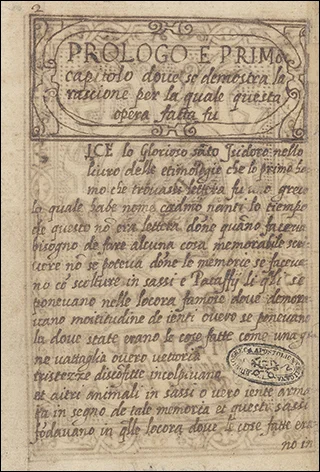
The Vatican manuscript is in Italian, written in an unknown hand, and opens with a prologue explaining why the work was composed — in the incipit's own phrasing: "Prologo e Primo capitolo doue se demostra la rascione per la quale questa opera fatta fu." 2 Its compiler is not identified in any catalog record.
Opening page of the Vita, from the DigiVatLib viewer. 3

Queen Christina's Rome and the Ottoboni library

The "Ott." in Ott.lat.2658 stands for Ottoboni — the manuscript's shelf prefix in the Vatican's Fondo Ottoboniano, a collection originally assembled by the Ottoboni family, one of Rome's prominent noble houses. Pope Alexander VIII (reigned 1689–1691) came from this family, and after his death the collection eventually passed to the Vatican Library, where it became one of the library's largest named funds. 6
The DigiVatLib catalog entry for the manuscript cites Susanna Åkerman's 1991 study Queen Christina of Sweden and her Circle (Brill) as a relevant scholarly reference — linking the manuscript's context to the intellectual world of Queen Christina of Sweden (1626–1689). 7 Christina abdicated her throne in 1654, converted to Catholicism, and settled in Rome the following year, where she became one of the most consequential cultural patrons of the Baroque: her Roman household attracted Arcangelo Corelli, Alessandro Scarlatti, and a circle of antiquarians, philosophers, and scholars. The presence of a Rienzo biography in the Ottoboni collection — a library shaped by the antiquarian currents of Christina's Rome — suggests that the story of Rome's medieval tribune still circulated as politically and intellectually charged reading material in Baroque intellectual circles, a mirror for thinking about Roman civic identity, popular authority, and the tension between people and pope.
Wagner was still two centuries away. His opera Rienzi, der letzte der Tribunen (Rienzi, the Last of the Tribunes) premiered in Dresden in 1842, and the 1835 novel by Edward Bulwer-Lytton that inspired it had not yet been written. But in 17th-century Rome, the story was already circulating in manuscript, copied out and kept in fine libraries. 1

Newly online

The Vatican Apostolic Library had paused its digitization activity between early May and mid-May 2026. When it resumed, the Week 20 batch — covering roughly May 11–17 — added 34 manuscripts to DigiVatLib, Ott.lat.2658 among them, upgraded from a lower-resolution scan to full HD. 2 The IIIF manifest for the manuscript records 382 digitized surfaces — front board, pastedown, and all leaves — viewable page by page through the DigiVatLib reader or any IIIF-compatible viewer. 3
This is the first Vatican manuscript covered by this channel.

Explore the manuscript

The full 382-page manuscript is freely available on DigiVatLib, with no registration required.
Loading link preview…
6
Cover image: manuscript cover of Ott.lat.2658, from DigiVatLib — Biblioteca Apostolica Vaticana

Add more perspectives or context around this Drop.

  • Sign in to comment.